Adsorption of surfactants at metal-water interfaces
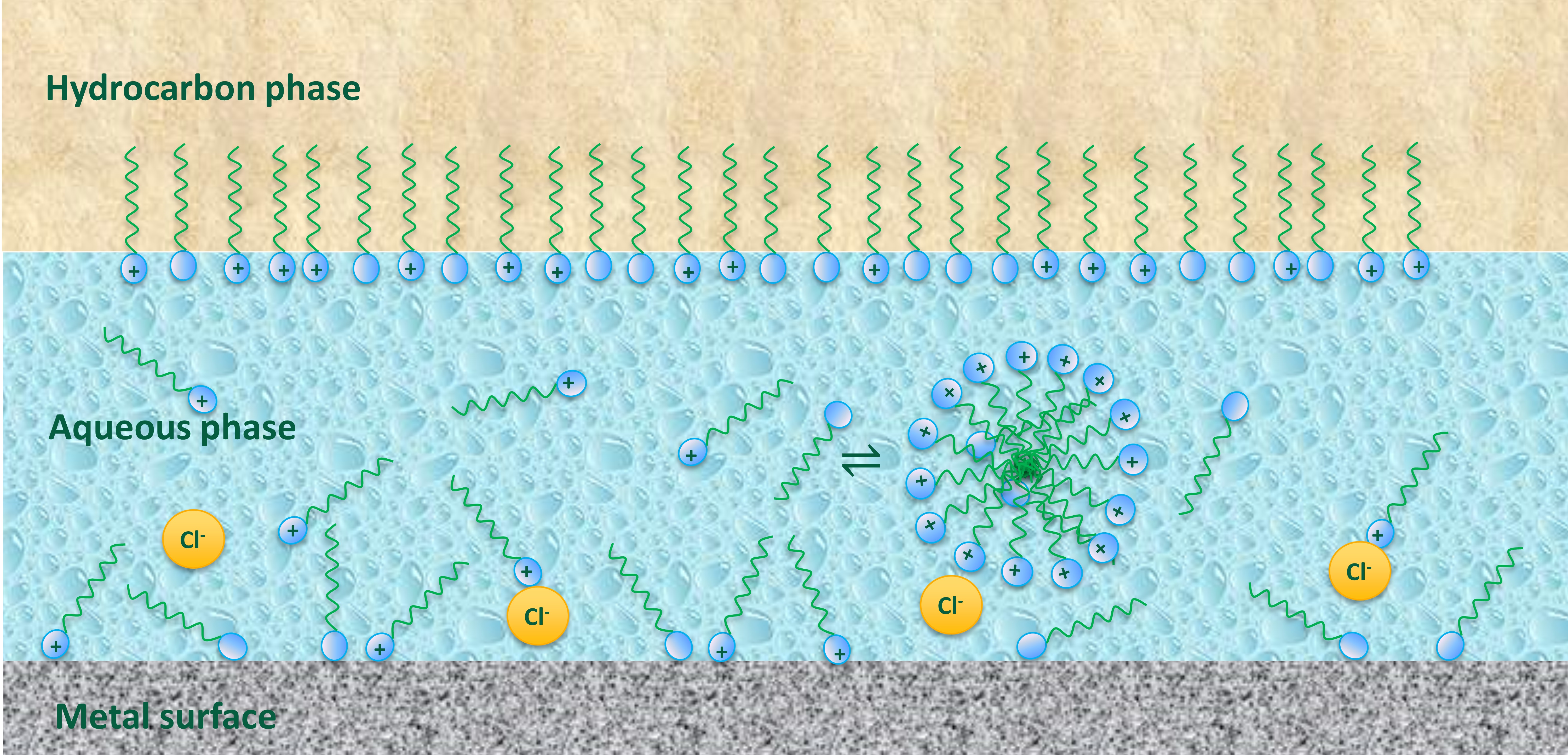
Surfactant adsorption at metal interfaces lies at the heart of fascinating processes such as corrosion prevention and catalytic reactions. Using a combination of coarse-grained and fully atomistic simulations, we’re delving into how these molecules organize, aggregate, and self-assemble at metal–water interfaces to reveal the molecular choreography driving these critical interactions.
Surfactant – nanoparticle interactions
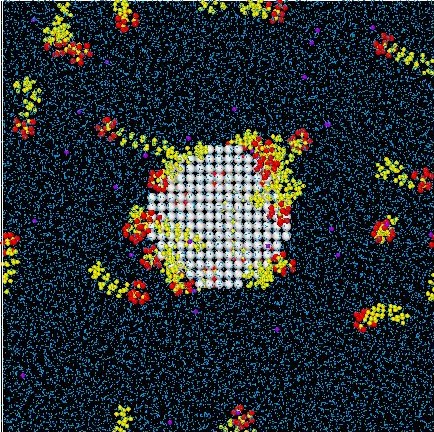
Surfactants are the artists behind the intricate shapes of metallic nanoparticles! By binding selectively to certain crystal facets, they guide nanoparticle growth into fascinating anisotropic forms. We’re exploring how surfactants adsorb and self-assemble across nanoparticles of different types, shapes, and sizes to reveal the molecular mechanisms behind shape control in nanomaterial synthesis.
Behavior of water in confined spaces
Water confined in tiny spaces behaves in fascinating ways—and these behaviors are key to many biological processes, from protein folding and lipid bilayer formation to protein–ligand binding. Beyond biology, such water-mediated interactions also shape the flow and rheology of particle suspensions. Our research explores how surface morphology and chemistry influence the thermodynamics of confined water, revealing the molecular principles that govern these complex systems.

Protein-protein interactions and protein-ligand binding
Proteins rarely act alone. They interact, assemble, and communicate to drive the essential machinery of life, from signaling and immunity to cell death. But when these partnerships misfire, the results can be devastating, leading to conditions such as diabetes, obesity, autoimmune disorders, and cancer. Using cutting-edge molecular simulations, we’re uncovering how proteins recognize and bind each other, and searching for small molecules that can block these aberrant interactions for promising new approaches to disease treatment.

Lipid bilayers and their interactions with nanoparticles
Cell membranes are extraordinary structures: flexible, self-assembling lipid bilayers that protect cells and control what goes in and out. We’re fascinated by how these membranes behave under changing conditions. Using advanced simulations, we study how lipid composition and temperature influence their phase behavior, and how nanoparticles with diverse chemistries can alter or disrupt this balance. Our goal is to uncover the molecular secrets behind membrane dynamics and nanoparticle–cell interactions.

 Sumit Sharma Research Group